
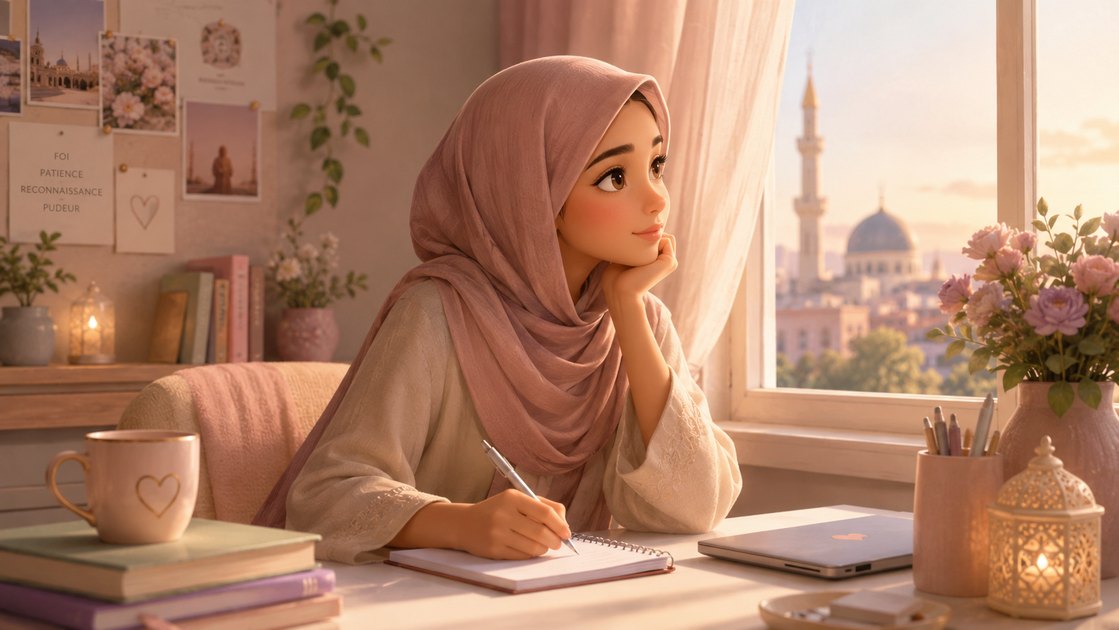
We often feel modesty before we even know how to define it. It is that slight hesitation before revealing too much of ourselves, that care in our speech, that desire to remain dignified without withdrawing from the world. For many Muslim sisters, how to live with Islamic modesty is not a theoretical question. It is a daily reality, balanced between faith, work, studies, family, friendships, and online presence.
Modesty in Islam is not limited to clothing, even though appearance is certainly part of it. It also concerns the gaze, intention, the way we speak, interact, and respect ourselves. The Prophet ﷺ said:
"Modesty is part of faith."
Reported by Al-Bukhari and Muslim.
This statement is simple, yet it places modesty at a very high level. It is not an optional addition to faith. It is connected to the condition of the heart.
How to Live Your Muslim Modesty Without Reducing It to Clothing Alone
It is easy to speak about modesty only in visible terms. Yet a sister may wear loose and appropriate clothing while still struggling with showing off, comparison, or the desire for attention. Conversely, a woman on a sincere journey may gradually learn to align her outward appearance with her inner state. Muslim modesty therefore requires consistency, not immediate perfection.
The Qur'an provides a clear foundation. Allah says:
"Tell the believing men to lower their gaze and guard their chastity. That is purer for them. Indeed, Allah is Fully Aware of what they do. And tell the believing women to lower their gaze and guard their chastity..."
(Surah An-Nur, 24:30–31)
The verse begins with the gaze and chastity before addressing appearance. This reminds us that modesty is first and foremost rooted in awareness of Allah.
Living with modesty therefore means learning to ask ourselves:
- What am I trying to show, and why?
- Does my speech bring peace or attract unnecessary attention?
- Does the way I behave protect my heart?
These questions are not meant to make us judge ourselves harshly. They help us return to a state of inner clarity.
The Modesty of the Heart
The modesty of the heart is the healthy discomfort we feel toward anything that distances us from Allah. It makes us more attentive to what we consume, what we publish, and what we allow into our private lives.
A modest sister is not necessarily withdrawn from society. She may be active, competent, and present in her community while maintaining an inner boundary.
That boundary is especially valuable in an age where exposure has become normal. Everything encourages us to share our lives, display ourselves, and compare ourselves to others. Muslim modesty teaches us that not all visibility is beneficial. There is strength in what we choose to preserve.
Modesty in Speech and Relationships
Allah also said to the wives of the Prophet ﷺ:
"Do not be soft in speech, lest he in whose heart is a disease should be moved with desire, but speak in an appropriate manner."
(Surah Al-Ahzab, 33:32)
Although this verse was addressed primarily to the Mothers of the Believers, scholars derive from it broader wisdom regarding restraint and dignity in speech.
This does not mean that a Muslim woman must become cold or invisible. It means that her kindness does not need to be suggestive in order to be beautiful. A woman can be warm, polite, and clear without creating unnecessary ambiguity. In work, studies, and daily interactions, this distinction matters greatly.
What Muslim Modesty Changes in Everyday Life
Modesty is not meant to complicate life. Rather, it creates a protective framework. When a sister chooses to live with greater haya (modesty), she often begins to simplify and reassess many things—not only her clothing, but also her habits, social circles, and even her reactions.
In clothing, there are well-known Islamic principles concerning coverage, looseness, and avoiding transparency. However, real-life situations often require wisdom and discernment. An outfit may be appropriate in one context and less appropriate in another. A beginner, a recent convert, and a woman returning to Allah will not all progress at the same pace. This mercy should remain present in how we view both ourselves and others.
On social media, modesty becomes a particularly important topic. Posting one's face, voice, private life, emotions, purchases, travels, children, or acts of worship all deserve reflection.
The issue is not only obvious haram. The issue can be more subtle: feeding other people's gaze, seeking validation, normalizing the exposure of private life, or weakening one's inner sense of protection.
This is not to say that every online presence is forbidden or harmful. Everything depends on intention, content, context, and the actual effect it has on the heart.
Some sisters use digital spaces to learn, work, teach, or connect with a healthy community. But modesty requires clear boundaries. Protecting one's image, avoiding unnecessary exposure, and choosing respectful environments are all part of that wisdom.
It is in this spirit that a private space designed specifically for Muslim women can make a real difference. On ukhti.me, the goal is not to encourage exposure, but rather to promote a calmer presence that is more aligned with modesty, trust, and sisterhood.
How to Live Your Muslim Modesty When You Are Still on the Journey
Many women feel guilty because they imagine that modesty must appear all at once, in a perfect and complete form. In reality, modesty is cultivated. It grows through faith, learning, and repeated choices.
A recent convert may love modesty long before she fully understands all of its dimensions. Likewise, a sister who has practiced Islam for many years may still discover areas in which she needs to improve.
The most beneficial approach is often to begin with what has the greatest impact on the heart:
- Reducing environments that normalize unnecessary mixing.
- Reconsidering how you present yourself online.
- Improving certain ways of speaking.
- Choosing more modest clothing.
- Surrounding yourself with women who inspire without making you feel inadequate.
These may seem like small changes, but they have the power to transform the soul.
The Prophet ﷺ said:
"Every religion has a distinctive characteristic, and the distinctive characteristic of Islam is modesty."
Reported by Ibn Majah and considered hasan by some scholars.
This hadith reminds us that modesty is not a cultural detail. It is deeply woven into Muslim identity.
At the same time, two extremes should be avoided.
The first is emptying modesty of its meaning until it becomes merely an aesthetic style.
The second is turning it into a permanent source of harshness toward ourselves and others.
True modesty brings us closer to Allah through humility. It does not feed spiritual arrogance or contempt for others.
For Converts and Sisters at the Beginning of Their Practice
If you are moving toward Islam, or if you have recently embraced it, allow yourself to learn without shame.
Muslim modesty can feel overwhelming at first because it touches many aspects of life.
Begin with the essentials: understand that your body, your heart, and your privacy all have value.
Islam does not ask you to disappear.
It teaches you how to preserve yourself.
You do not need to have everything figured out in order to be sincere.
Sincerity means wanting to please Allah and taking real steps forward, even small ones.
Some improvements will be visible.
Others will remain hidden within the heart.
Both matter.
Modesty Does Not Erase Personality
There is sometimes a quiet fear:
"If I become more modest, will I become dull, invisible, or insignificant?"
The answer is no.
Modesty does not erase personality.
It refines it.
It allows a person to exist without placing herself before every gaze.
A Muslim woman can be creative, intelligent, ambitious, humorous, cultured, and deeply modest at the same time.
Modesty does not remove her light.
It gives that light direction.
Most importantly, it prevents personal worth from becoming dependent on external validation.
In practical terms, this may mean:
- Learning to say no without guilt.
- Refusing certain social environments.
- Protecting private conversations.
- Keeping some joys private.
- Making clothing choices that bring peace to the heart.
All of this sometimes requires courage.
But it is a gentle kind of courage, because it comes from loyalty to Allah.
There will be easier days and harder days.
There will be moments of clarity, and moments of fatigue, doubt, or social pressure.
That is normal.
Modesty is not a fixed state.
It is a direction that must be renewed again and again.
And often, the more sincerely it is lived for Allah, the more it becomes a source of quiet peace—a way of living in the world without losing oneself.
Keep this one truth close to your heart:
Muslim modesty was not meant to extinguish you.
It was meant to protect you, elevate you, and bring you closer to Allah with dignity.