
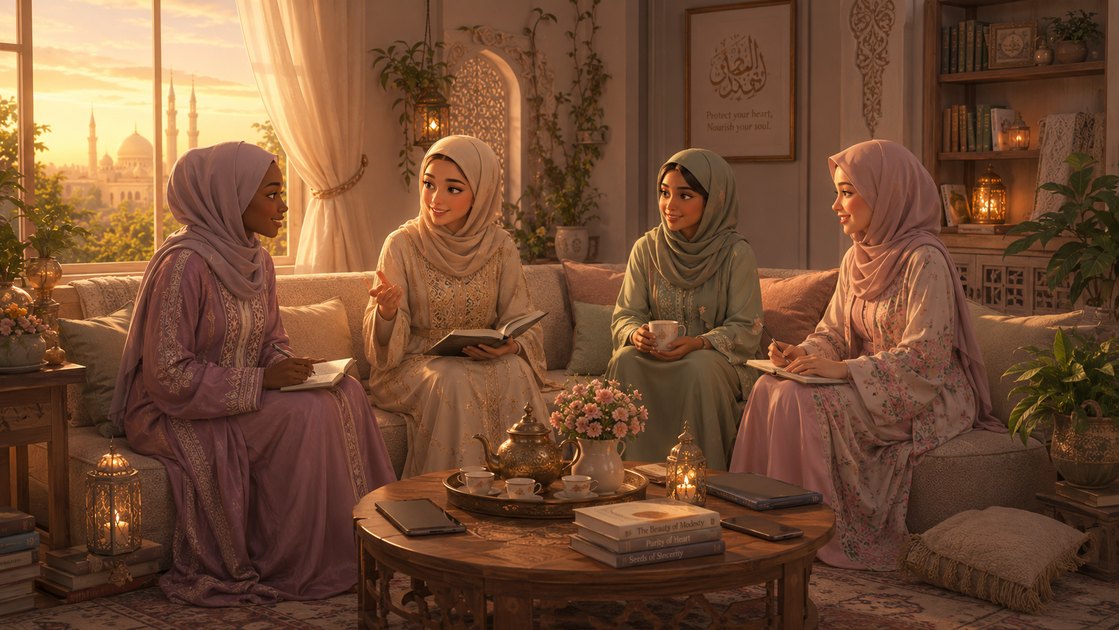
Choosing a modest Islamic lifestyle is not only about thinking about what to wear. It is often a more personal and far-reaching decision that affects the way one speaks, presents oneself, consumes, builds relationships, and protects the heart. Many sisters feel drawn to it early on, while others arrive at it after a period of questioning, and still others after embracing Islam. In every case, this journey deserves more than quick instructions and simplistic advice. It requires gentleness, knowledge, and a safe environment.
A Modest Islamic Lifestyle Is Not Limited to Appearances
Modesty in Islam is visible, of course, but it is never merely visual. The Prophet ﷺ said:
"Modesty is part of faith."
This narration, reported in Sahih Al-Bukhari and Sahih Muslim, places modesty at the heart of a believer's identity. That changes everything. We are not speaking about a simple aesthetic lifestyle or an empty social code, but rather an inner quality that is reflected outwardly.
The Qur'an also reminds us of an essential principle:
"Tell the believing men to lower their gaze and guard their chastity..." "And tell the believing women to lower their gaze and guard their chastity..."
These verses are found in Surah An-Nur, verses 30 and 31. They show that modesty concerns the gaze, intention, and personal boundaries long before it becomes a question of clothing.
This is where an important nuance must be introduced. Yes, clothing matters. Yes, the way we present ourselves matters. But a sister may adopt outwardly compliant clothing while feeling exhausted by comparison, constant exposure, or social pressure. On the other hand, a sister sincerely striving to improve may still be learning certain visible aspects while having a heart fully turned toward Allah. A balanced Islamic perspective holds both dimensions together: outward effort and inward purification.
Living Modesty in Everyday Life
A modest Islamic lifestyle is built through ordinary actions. It appears in the way we speak about ourselves, in what we publish, in the influences we allow into our homes and minds. It can be seen in the content we consume, the company we keep, and the way we preserve our dignity at work, at university, within the family, or online.
For many Muslim women today, the challenge is not simply knowing what is recommended. The real challenge is living these principles in environments that do not always respect them. It can be difficult to remain discreet in a culture that rewards visibility. It can be exhausting to explain one's reserve in environments that interpret modesty as a lack of confidence. It can even be painful to feel the need to constantly justify oneself.
This is why it is important to say clearly: modesty is not self-erasure. It does not diminish a Muslim woman's intelligence, presence, or ambition. Rather, it gives structure to her dignity. It helps her choose when to be visible, whom to trust, how to speak, and what she refuses to normalize. In this sense, modesty protects far more than it restricts.
The Modest Islamic Lifestyle in the Digital Age
Today, many of the tensions surrounding modesty are connected to digital life. We no longer live only within a neighborhood, a family, or a social circle. We also live through interfaces, images, private messages, algorithms, and forms of exposure that can feel permanent. A modest Islamic lifestyle must therefore also be considered within this space.
The first question is not merely, "What can I post?" but rather, "Why do I want to post it?" Are we sharing something beneficial, or are we seeking validation and attention? The answer is not always simple, and that is perfectly normal. We all want to be seen, understood, and appreciated. Yet Islam teaches us not to place our private lives before the gaze of everyone.
In this context, choosing more protected environments becomes an act consistent with one's values. For a sister who wishes to connect with others, find resources, discover events, or explore products aligned with her ethics without sacrificing her peace of mind, an environment designed specifically for Muslim women can genuinely transform the experience.
This is also the spirit behind platforms such as Ukhti, available at https://ukhti.me. They are not simply social networks, but spaces that place greater emphasis on modesty, privacy, and sisterhood.
Between Firmness and Mercy Toward Yourself
Some sisters approach modesty with great sincerity but also with such inner harshness that it eventually weakens them. They want to correct everything at once, align every aspect of their lives immediately, and experience every setback as proof of failure. This approach may appear pious, but it can become discouraging.
Allah says in the Qur'an:
"Allah intends ease for you and does not intend hardship for you." (Surah Al-Baqarah, 2:185)
This verse does not mean that obligations disappear whenever they require effort. Rather, it reminds us that the religion was not revealed to break believers. Progressing toward greater modesty may take time. There are stages, moments of realization, occasional setbacks, and renewed determination.
For a convert or a sister returning to religious practice, this point is essential. A modest Islamic lifestyle is not a performance. It is a journey of obedience and closeness to Allah. One may gradually learn to review her wardrobe, her relationship with social media, her personal boundaries, her consumption habits, and her social circles. What matters most is the sincerity of the next step.
Modesty Also Concerns Relationships and Speech
People often speak about clothing, but less about speech. Yet modesty is also present in the way we converse, joke, share personal stories, and enter into the lives of others. Modest speech is not cold speech. It is measured, honest, and respectful of emotional boundaries.
Modesty also has a place in relationships between women. It protects against excessive curiosity, oversharing intimate matters, harmful comparisons, and envy. It allows for healthier sisterhood, where women can support one another without policing each other, advise one another without humiliation, and inspire one another without creating competition.
This point deserves emphasis, especially in a context where much so-called "modest" content itself becomes a display of image and consumption. There can be a real tension between inspiration and exhibition. Sharing a beautiful outfit to provide ideas may be beneficial. But when everything revolves around appearance, status, or public attention, the deeper meaning of modesty begins to fade.
Building an Environment That Supports Modesty
Personal modesty is easier to maintain when the environment is not constantly working against it. This concerns friendships, content, habits, and discussion spaces. An isolated sister will often find it more difficult to remain committed to her choices than a sister surrounded by people who understand her values without judging her.
Seeking righteous companionship is not a luxury. It is practical support. The Prophet ﷺ said:
"A person follows the religion of his close friend, so let each of you look carefully at whom he takes as a close friend."
This hadith is reported by Abu Dawud and At-Tirmidhi. For many Muslim women, it means choosing spaces where they do not have to constantly negotiate their identity.
A good environment does not demand perfection. It offers support, discretion, and beneficial reminders. It leaves room for sincere questions. It also welcomes those who are still learning, including new Muslim women who are gradually discovering the practical dimensions of Islamic modesty.
What Modesty Truly Brings
When properly understood, modesty does not suffocate. It brings peace. It resolves many inner dilemmas because it restores order to one's priorities. One no longer seeks validation from everyone. One learns to protect what is precious. One becomes more attentive to what nourishes faith and less dependent on the changing opinions of others.
This does not mean everything becomes easy. There will be days of fatigue, uncertainty, and sometimes loneliness. Yet there is also a deep stability in living according to boundaries that Allah has honored. For many sisters, this is where a quieter but stronger form of peace begins.
If you are seeking to adopt a modest Islamic lifestyle, do not begin by trying to appear flawless. Instead, strive to become more consistent, step by step, between what your heart already knows, what Allah loves, and the environment in which you choose to grow.