
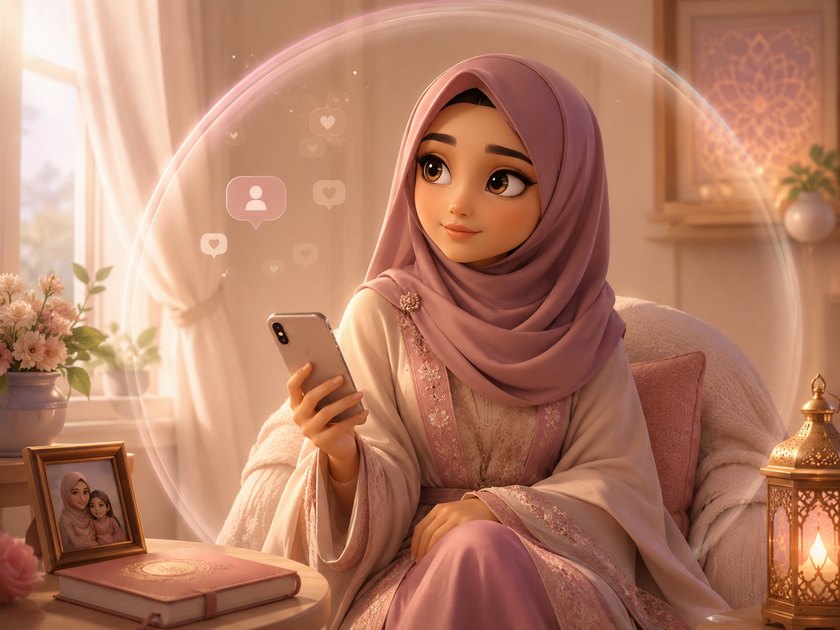
One almost never regrets keeping something to oneself. An unpublished photo, an untold family detail, a discussion left out of sight - often, this is where serenity begins. For many sisters, asking how to preserve one's Muslim privacy is not a secondary question. It is a concrete way to protect one's faith, modesty, tranquility, and home.
In a digital world where everything pushes to show, comment, and expose, discretion can seem strange. Yet, in Islam, it has real value. Allah says in the Quran: "O you who have believed, avoid much assumption. Indeed, some assumption is sin. And do not spy" (Surah Al-Hujurat, 49:12). This verse does not only speak of the gaze cast upon others. It also reminds us that a healthy community is built neither on intrusion nor on permanent exposure.
Why preserving your Muslim privacy is an act of protection
Preserving your privacy is not about living hidden or becoming cold. It is about putting everything in its rightful place. Not everything must be public, and not everyone has the right to know everything. This restraint protects the heart against comparison, protects the couple against interference, and protects children against a visibility they did not choose.
The Prophet ﷺ said: "Part of a person's good practice of Islam is leaving alone that which does not concern him." This hadith, reported among others by At-Tirmidhi, sets a very simple framework. If some people must learn not to ask too much, we too must learn not to give away too much.
There is also a more intimate dimension. When a Muslim woman tells everything, publishes everything, or constantly seeks validation from others, she may end up no longer knowing what truly belongs to her. Conversely, keeping a part of oneself sheltered gives density back to inner life. This helps cultivate sincerity in one's intentions, away from the human gaze.
Modesty is not just about appearance
We often talk about modesty in clothing, and that is normal. But modesty also touches speech, image, emotions, and even the details of daily life. A house, a marriage, a pregnancy, an argument, a financial trial, or a personal joy do not all have to become content.
The Prophet ﷺ said: "Modesty is part of faith" (reported by Al-Bukhari and Muslim). This modesty does not stop at physical space. It also accompanies the way we show ourselves online, how we describe ourselves, and how we let others into our lives.
This requires discernment. Speaking to seek support is not the same as exposing oneself. Sharing a beneficial reminder is not the same as turning one's intimacy into a storefront. Intention matters, of course, but consequences matter too. A post can be made with a good intention and still produce envy, intrusion, gossip, or heart fatigue.
How to preserve your Muslim privacy on social networks
Social networks blur boundaries. We think we are speaking to a few people, but sometimes we are addressing hundreds, or even more. We think we are publishing an innocuous moment, while we are revealing our address, our children's habits, the interior of our home, our standard of living, or the state of our relationship.
The first useful reflex is to slow down. Before posting, one must ask: is it necessary, is it modest, is it durable, and would I be comfortable if this post circulated out of my control? This simple pause prevents many regrets.
The second reflex is to do an honest sorting. Some people keep contacts out of politeness, then share very personal aspects in front of them. However, digital proximity is not real trust. A small and safe circle is better than a large but vague audience.
The third reflex is technical, but it is not superficial. Privacy settings, a pseudonym if necessary, limiting private messages, refusing automatic geolocation, caution with children's photos - all of this is part of the ethics of protection. Faith does not replace vigilance. It guides it.
Topics that almost always deserve more discretion
Certain areas of life require special protection. The couple is one of them. Marital tensions told too early, too widely, or to the wrong people often create more confusion than relief. Seeking advice is sometimes necessary, but this should be done with a reliable, wise person who respects confidentiality.
Children too have a right to their privacy. A childhood archived online without restraint can become a burden later. Their image, their health, their habits, their emotions do not entirely belong to us.
There are also the blessings that Allah grants us. Every blessing shown is not a blessing protected. Without falling into fear or permanent suspicion, many sisters note that a preserved joy more easily keeps its barakah. Saying less can sometimes be a form of deeper gratitude.
Between isolation and overexposure, finding a fair path
Preserving your Muslim privacy does not mean isolating yourself. A sister needs connection, advice, support, moments of relaxation, a space where she can be understood without having to justify herself. The real challenge is therefore not to disappear, but to choose where and with whom one makes oneself visible.
This is where the environment matters enormously. On generalist platforms, one often has to protect oneself against codes that respect neither modesty, nor boundaries, nor Muslim sensitivity. Over time, this is exhausting. Being present somewhere is not enough. That place must also be healthy for oneself.
For a sister looking for a more respectful framework, a space designed for Muslim women can make a real difference. On ukhti.me, the idea is not to push for exposure, but to foster a safer presence, more aligned with modesty, trust, and the need for community among sisters.
Preserving your mental peace is also part of privacy
We often think of privacy as a matter of information. In reality, it is also a matter of energy. Who has access to you? Who can write to you at all hours? Who comments on your appearance, your choices, your practice, your pace of life?
Setting boundaries is not a lack of generosity. It is sometimes a spiritual necessity. If each day brings its share of comparisons, misplaced curiosity, or heavy discussions, the heart eventually closes. Privacy also serves to preserve an inner space where faith can breathe.
This can involve simple gestures: answering later, not explaining everything, refusing certain conversations, or no longer giving access to people who constantly cross boundaries. All of this is particularly important for new converts or those who are still finding their way. When building one's balance, one sometimes needs less noise around oneself.
Discretion as daily adab
Discretion is cultivated as a habit. It is seen in the way one speaks of one's husband, one's friends, one's projects, and even one's acts of worship. Every good thing does not need to be told. Every problem does not need to be broadcast.
The pious predecessors attached great importance to restraint. Not out of harshness, but because they knew that the heart loses its sincerity when it seeks too much the gaze of people. Today, this wisdom is even more precious, because exposure has become commonplace.
It is not about being afraid of everything. It is about learning the right dosage. A sister can be warm without being transparent, present without being exposed, sociable without making herself accessible to everyone. This nuance changes many things over time.
When sharing becomes fair
There are of course moments when speaking is beneficial. Asking for help, testifying to support other women, recommending a useful resource, announcing an event, sharing a sincere reminder - all of this can be beautiful and useful. But the criterion remains the same: does this sharing serve a real good without sacrificing the intimacy that one must protect?
If the answer is hesitant, it is often better to wait. What is kept one day can be shared later with more perspective, more wisdom, and less risk. Silence, sometimes, is not a lack. It is a maturity.
A preserved private life is not a poor life. It is often a more stable, sweeter, and more inhabited life. And for a Muslim woman, this discretion can become a form of quiet dignity - one that does not seek to be seen everywhere to remain whole before Allah.