
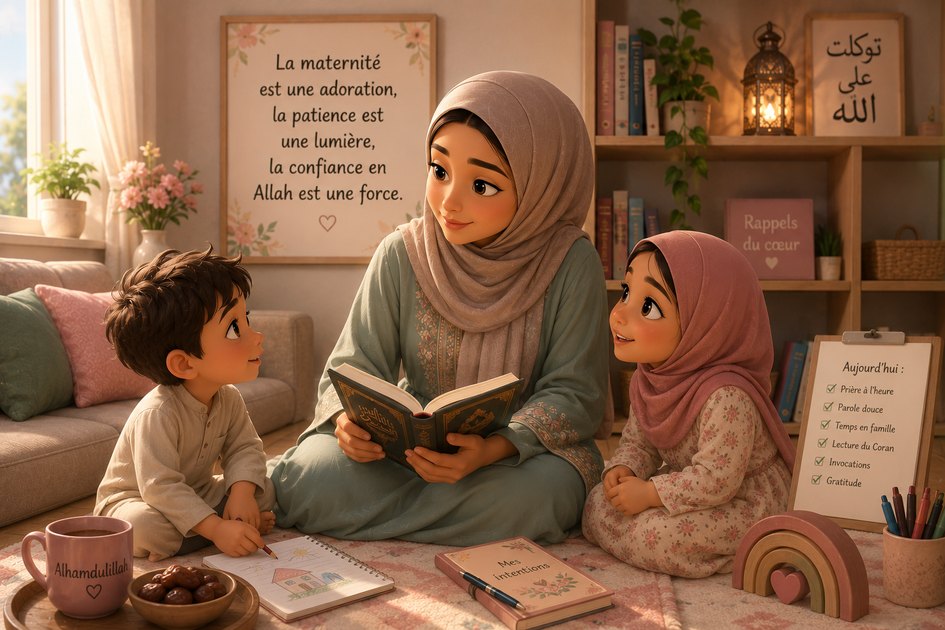
Some days begin before Fajr, with a crying baby, a kitchen to tidy, a mental load that is already well installed, and that quiet feeling of never doing quite enough. This is often when advice for Muslim mothers takes on its full meaning — not to add more rules to follow, but to return to a gentler, more balanced, more grounded way of living motherhood.
Being a mother, in Islam, is not a performance. It is a noble responsibility, but also a trial, with its intense joys and silent weariness. Between raising children, married life, religious obligations, extended family, and sometimes work, many sisters carry far more than is visible. And if you are a recent convert or on your way to Islam, this load can come with an added sense of loneliness.
The Prophet ﷺ left us a saying that puts things back in their place: "Actions are judged by their intentions." Reported by al-Bukhari and Muslim. A mother who prepares a meal, comforts a child, stays up late, patiently starts over a thousand times, can turn her daily life into worship if her intention is directed toward Allah.
Advice for Muslim mothers when everything feels too heavy
The first piece of advice is not to do more. It is to accept your limits without excessive guilt. Many devout mothers fall into a subtle trap: wanting to be perfectly present, perfectly organized, perfectly gentle, and perfectly practicing all at once. Yet Islam does not ask us for perfection. It asks us for sincerity, effort, and a return to Allah.
Allah says in the Quran: "Allah does not burden any soul with more than it can bear." Surah Al-Baqarah, 2:286. This verse does not erase tiredness, but it gives it a framework. If a season is harder, if your home is not spotless, if your energy is low, it does not mean you are a bad mother. It simply means you are human.
However, there is an important nuance. Welcoming your limits does not mean slipping into neglect. It means distinguishing what is essential from what is secondary. Praying on time, feeding your children with care, keeping dignified speech, asking forgiveness when you lose your temper — that is the core. The rest can sometimes wait.
Returning to a livable faith, not an idealized one
Some mothers compare themselves to unrealistic images of a Muslim motherhood that is always peaceful, always tidy, always smiling. This vision causes harm. A livable faith is one that fits into real everyday life. Sometimes the Quran will be read in calm. Sometimes it will be listened to between two tasks. Sometimes dhikr will be done with a child in your arms. And that counts.
The best framework is not necessarily the most perfect, but the most consistent. A few morning invocations, saying the basmalah often, a small habit of family gratitude after meals, a surah recited before bed — these simple gestures create a home that breathes faith without making it overwhelming.
Protecting your heart to better raise your children
A mother passes on more through her inner state than through her words. A child notices if their mother is constantly tense, rushed, irritated, or emotionally absent. This does not mean she must never falter. It means that taking care of her heart is part of raising her children.
The Prophet ﷺ said: "Indeed, in the body there is a piece of flesh which, if it is sound, the whole body is sound, and if it is corrupt, the whole body is corrupt. Indeed, it is the heart." Reported by al-Bukhari and Muslim.
For a mother, protecting her heart can take the form of very concrete choices. Reducing what feeds dissatisfaction. Moving away from spaces where you constantly compare yourself. Being careful of content that normalizes immodesty, harshness, or contempt for the maternal role. Seeking instead safer, more aligned, more caring feminine environments.
It is in this spirit that a private space designed for Muslim women can do good. Some sisters need a place where they can share without overexposing themselves, ask questions, find comfort, discover useful resources, and feel understood. Ukhti was created precisely for that, in a spirit of modesty, trust, and sisterhood.
Patience does not mean enduring everything alone
We hear a lot about sabr, sometimes to the point of distorting it. Patience in Islam is not the obligation to stay silent about everything, nor to carry every burden alone. A Muslim mother can ask for help, share tasks, say she is exhausted, consult a trusted person, or seek a healthy community.
Even Maryam, whom Allah honored, went through immense pain. Allah says: "And the pains of childbirth drove her to the trunk of a palm tree, and she said: Oh, would that I had died before this and had been completely forgotten." Surah Maryam, 19:23. This verse gently reminds us that a pious woman can experience real distress. Her worth is not diminished by it.
Educating with rahma before wanting to correct everything
Many mothers want to pass on good habits very early — prayer, hijab later on, respect, the Quran, good behavior. This intention is noble. But Islamic upbringing is not built only through correction. It is built through rahma, through repetition, through example, through attachment of the heart.
The Prophet ﷺ did not educate with harshness. He guided, corrected with wisdom, and left room for gradual learning. With children, this means not turning every mistake into a battle. Not everything deserves the same intensity. There are mistakes to correct clearly, and there is normal immaturity to accompany.
A tired mother can become harsher than she wishes. If this happens to you, the most helpful thing is not to sink into shame. It is to repair quickly. Saying sorry to your child when you have gone too far does not lower your authority. On the contrary, it teaches humility and responsibility.
A Muslim home does not need to be rigid
Some families want to do so well that they create a very controlled atmosphere, with little joy and many injunctions. Yet a Muslim home can be serious without being cold. One can hear reminders there, but also laughter. One can teach adab without installing permanent tension.
The middle path is precious. Too much laxity weakens boundaries. Too much rigidity pushes hearts away. It also depends on the children's age, the mother's temperament, the father's support, and the family context. A convert, for example, will sometimes need to lay the foundations little by little, without skipping steps.
Advice for Muslim mothers who want to last, not just hold on
Many women know how to hold on. Few learn how to last. Holding on is surviving the week. Lasting is building a sustainable daily life. For that, you have to give up the idea that a good mother says yes to everything.
Preserving your energy is a responsibility. It can mean simplifying meals on certain days, cutting back on unnecessary outings, setting up a quiet time for the children, refusing some unrealistic family expectations, or sleeping when possible instead of maintaining an invisible social pressure.
The Messenger of Allah ﷺ said: "Your body has a right over you." Reported by al-Bukhari. This hadith is deeply fitting for mothers. If your body breaks down, your patience decreases, your focus drops, and your worship becomes harder. Rest, in due measure, is not a Western luxury. It is sometimes a condition for spiritual stability.
For converts and mothers on the path
If you have just embraced Islam, or are still learning, do not let anyone make you believe you must master everything at once. Motherhood and religious learning at the same time can be very intense. Go step by step. Start with the sure basics. Ask questions. Seek reliable sisters. Protect yourself from quick judgments.
Passing faith on to your children does not depend on perfect religious vocabulary. It depends on simple consistency. Saying bismillah, showing gratitude, speaking of Allah with love, learning a short surah, instilling modesty with gentleness — all of this already counts for a great deal.
If you feel the need to share with other women who understand this reality, creating an account at https://ukhti.me/register can be a reassuring first step. Sometimes, a conversation with a kind sister lightens the load more than a long speech.
Being a Muslim mother is not about resembling an ideal image. It is about returning, again and again, to a sincere, modest, merciful, and possible motherhood — one in which Allah sees your efforts, even when no one else notices.