
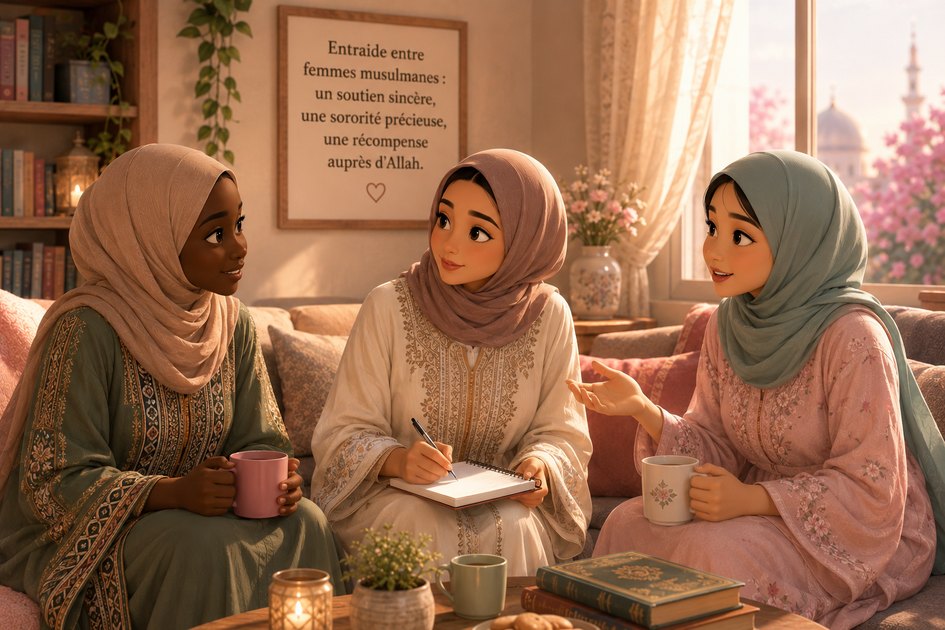
There are days when a sister simply needs a gentle reminder, a listening ear, or a message sent at exactly the right moment. Support between Muslim women does not necessarily begin with large projects or organized initiatives. More often, it begins with simple, sincere, almost invisible acts that genuinely make life easier.
For many Muslim women, the need is not only to speak. It is to be understood without having to justify everything—modesty, religious practice, personal boundaries, life choices, efforts in faith, and even doubts. When that space does not exist, isolation quickly settles in. And when it does exist, it becomes a mercy.
Allah says in the Qur'an:
"The believing men and believing women are allies of one another. They enjoin what is right, forbid what is wrong, establish prayer, give zakah, and obey Allah and His Messenger."
(Surah At-Tawbah, 9:71)
This verse establishes a very clear foundation: solidarity is not an extra comfort. It is a shared responsibility.
Why Support Between Muslim Women Matters So Much
We often speak about community in abstract terms. In reality, a community is measured in concrete moments: a sister who watches a child while another attends an appointment, a sister who shares a halal job opportunity, or another who reassures a convert before her first Ramadan.
Support between Muslim women has social, emotional, and spiritual dimensions.
Socially, because it responds to real needs that many women carry silently.
Emotionally, because it protects against loneliness and constant comparison.
Spiritually, because it helps women remain firm without becoming harsh, and gentle without becoming naïve.
The Prophet ﷺ said:
"A believer to another believer is like a building whose parts support one another."
Then he interlocked his fingers.
This hadith is reported by Al-Bukhari and Muslim.
Although the narration addresses believers generally, its spirit speaks powerfully to Muslim sisterhood: we were not created to walk this path alone.
For a woman born into Islam, this support can help her navigate life's stages with greater stability.
For a woman who is converting or has recently converted, it can mean the difference between living faith with peace and living it with confusion.
Much often depends on the quality of the people surrounding her.
Helpful Support, Not Intrusive Support
Helping one another does not mean monitoring others, correcting them without tact, or imposing one's pace upon them.
This point is essential.
In some spaces, the desire to do good can slowly turn into judgment.
Yet true support respects the dignity of the person being helped.
There is a difference between offering reminders with rahma (mercy) and placing religious pressure upon someone.
There is also a difference between giving advice and making oneself indispensable.
The goal is not to create emotional or moral dependency.
It is to strengthen a sister so that she can draw closer to Allah with greater peace and confidence.
The Prophet ﷺ said:
"Religion is sincere advice."
(Reported by Muslim)
But sincere advice comes with conditions: kindness, discretion, knowledge when discussing religious matters, and awareness that every person is carrying realities we may not see.
Sometimes helping simply means not asking for too many details.
A sister may need a meal, a recommendation, a trustworthy contact, or supportive company after receiving bad news without wanting to explain everything she is carrying.
Respecting that modesty is also part of good adab.
How to Build Genuine Support Between Muslim Women
Strong sisterhood is built less through grand speeches and more through good habits.
The first habit is consistency.
A message sent once every six months after a long absence does not have the same impact as a regular presence, even if that presence is light.
The second habit is listening without competition.
Many Muslim women carry multiple responsibilities at the same time—family, studies, work, community commitments, mental health challenges, and religious learning.
When every conversation becomes a place where people feel the need to prove they are coping better than others, the bond weakens.
When the conversation becomes a refuge, the bond grows.
The third habit is practical support.
The value of concrete acts is often underestimated.
Sharing a trusted recommendation for a halal service, suggesting a respectful therapist, informing others about a useful event, supporting the project of a Muslim woman entrepreneur, or helping a convert understand an administrative process—these actions matter tremendously.
The fourth habit is protecting a sister's honor.
In any community relationship, trust can be destroyed by the circulation of private information.
A sister who confides a difficulty should never become the subject of casual conversation.
Without that sense of security, healthy closeness cannot exist.
Allah says:
"O you who believe, avoid much suspicion... and do not backbite one another."
(Surah Al-Hujurat, 49:12)
This verse is not only about open conflicts.
It also addresses environments where gossip, assumptions, and unnecessary comments become normalized.
Needs Differ According to Each Person's Journey
Not all Muslim women are looking for the same kind of support.
A student living far from her family does not have the same needs as an isolated mother, a professional seeking a values-based network, or a woman discovering Islam and searching for guidance.
Recognizing this does not weaken the idea of sisterhood.
On the contrary, it makes it more just and realistic.
For a convert, support often requires clarity and gentleness.
Questions should be answered without overwhelming her with excessive information.
She should be helped to distinguish between religion, culture, and personal habits.
And she should be given the time she needs to grow.
Trying to teach everything at once may discourage rather than support.
For a sister who has practiced Islam for many years, support may take a different form.
She may need a space where she can rest from expectations, speak honestly about spiritual fatigue, or find relationships that do not reduce religion to appearances.
Here too, the quality of the relationship makes all the difference.
Creating Safe Spaces for Support Between Muslim Women
Good intentions alone are not enough.
Healthy structures are also necessary.
A support space for Muslim women should be reassuring, modest, and trustworthy.
This requires knowing who enters the space, what types of interactions are encouraged, and what boundaries exist to protect members.
On mainstream platforms, many Muslim women hold back.
They filter what they say, anticipate misunderstandings, or avoid certain topics because trust is lacking.
This is not a minor issue.
When an environment does not respect modesty and safety, beneficial conversations become increasingly rare.
This is why a space designed specifically for sisters can transform the quality of interactions.
On Ukhti, Muslim women can find a private and caring environment centered on connection, useful events, and discovering resources aligned with their values.
For those seeking a more peaceful community, an account can be created at:
https://ukhti.me/register
Even within a healthy environment, however, support still requires personal effort.
Technology can facilitate connection, but it cannot replace sincerity.
A safe space opens the door.
Trust is then built through intentions, words, and consistency.
When Helping Also Means Referring to Someone More Qualified
There are situations where the best form of support is not answering the question yourself.
A fiqh question requires a reliable and well-founded answer.
A serious psychological struggle may require professional support.
A complex marital or family issue may require wisdom, experience, and specialized guidance.
Knowing how to say, "I don't know," is a sign of maturity.
Trying to be the solution to everything can cause harm, even when the intention is good.
Muslim sisterhood is not about constant improvisation.
It is also about the humility to direct a sister toward what will genuinely benefit her.
The Prophet ﷺ said:
"When Allah intends good for someone, He grants him understanding of the religion."
Reported by Al-Bukhari and Muslim.
This reminds us of a simple truth: sincerity does not replace knowledge in religious matters.
Making Sisterhood a Habit of Faith
Support does not need to wait for a crisis.
It can become a way of living one's faith.
Checking on a sister without intrusive curiosity, making du'a for her without telling her, sharing a useful opportunity, welcoming a newcomer with kindness, or defending an absent sister when she is misunderstood—these are quiet acts, yet they carry immense value.
In a world where many relationships are fast, public, and fragile, Muslim women need something different.
They need spaces where modesty is not an obstacle, where faith is not treated as a secondary detail, and where the presence of other sisters brings relief rather than pressure.
If each of us begins asking not "How can I be seen within the community?" but rather "How can I make another sister's journey a little easier?", something profound begins to change.
And very often, that is where barakah enters relationships.
Support between Muslim women is not merely a social convenience.
It is an expression of faith.
It is one of the ways believers carry one another through life's difficulties, celebrate one another's blessings, and remain connected to what is good.
The strongest communities are rarely built through visibility or popularity.
They are built through sincere hearts, trustworthy words, and small acts of kindness repeated over time.
And sometimes, a single message, a sincere du'a, a practical recommendation, or a moment of genuine presence can have a greater impact than we will ever know.
That is the beauty of Muslim sisterhood.
It does not always appear dramatic or extraordinary.
Often, it simply means being a source of mercy for another sister on her journey to Allah.