
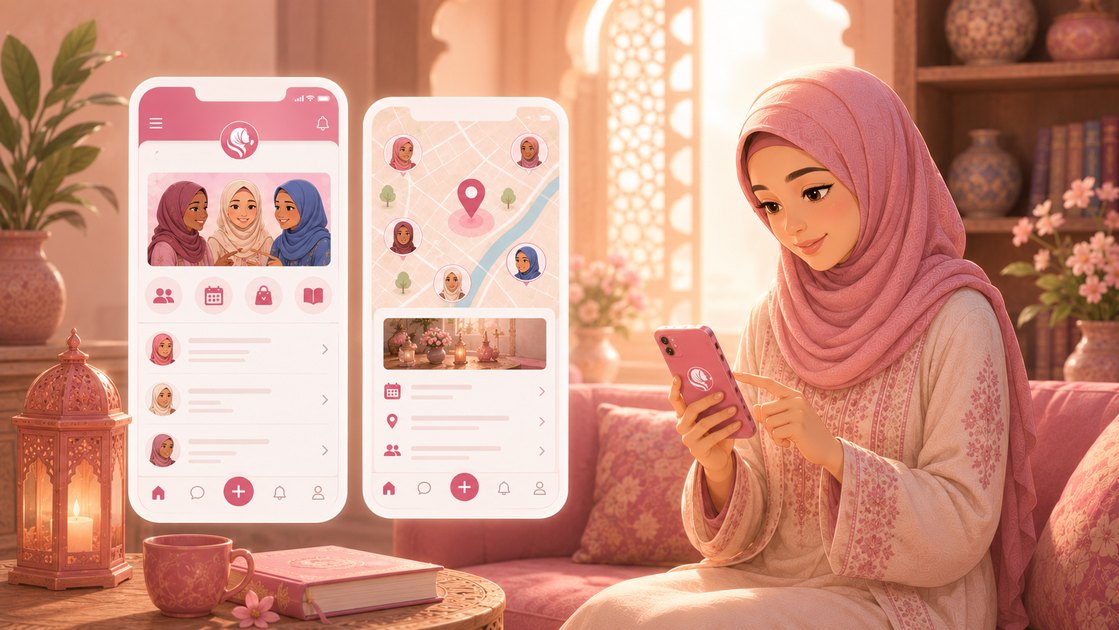
Muslim App for Women – What Should You Look For?
When a sister opens her phone looking for a space that respects her modesty, her faith, and her way of life, she is not simply looking for another platform. More often, she is looking for a safe place. This is where the question of a Muslim app for women becomes concrete: is it truly a space that understands the needs of Muslim women, or just another interface with a few religious aesthetics on the surface?
The topic deserves more than a simple list of features. For many Muslim women, an app is not only meant for chatting or endlessly scrolling through content. It can become a discreet support in everyday life, a circle of trust, a place to discover events, halal products, useful discussions, and a community that does not require them to put their values aside.
Why a Muslim App for Women Fulfills a Real Need
Mainstream platforms promise connection. Yet they often leave little room for modesty, privacy, and alignment with Islamic values. A Muslim woman may feel exposed, misunderstood, or simply tired of constantly filtering what she sees, what she shares, and the way she interacts.
An app designed for Muslim women starts from a different perspective. It does not see modesty as a limitation to work around, but as a reality to respect. It does not treat the search for safety as a hidden option buried in settings, but as a foundation. This difference changes many things, especially for women who want to stay connected without entering environments that blur their boundaries.
This is not about isolating users in a narrow space either. On the contrary, a well-designed dedicated environment can open calmer and healthier possibilities: speaking with other sisters, discovering local initiatives, finding trustworthy recommendations, buying relevant halal products, or participating in community life without unnecessary discomfort.
What Makes a Good Muslim App for Women
Not all apps targeting a religious audience are equal. Some are highly useful for personal spirituality, for example for the Quran, prayer times, or dhikr. Others focus more on community, lifestyle, or commerce. The right choice therefore depends on what you are truly looking for.
The first criterion is privacy. An app may display reassuring messaging, but if the experience pushes users toward overexposure, the promise does not hold up. You should look at how profiles are displayed, who can contact whom, what information is requested, and whether interactions take place in a respectful environment. For many women, this question comes before everything else.
The second criterion is the quality of the community. A space reserved for or oriented toward Muslim women is not automatically kind or supportive. What matters is how the atmosphere is built. Is there a culture of support between sisters? Are the contents useful, balanced, and respectful? Do the conversations make you want to stay, or do they create the same exhaustion as traditional social networks?
The third criterion is real usefulness. An app can be beautifully designed while remaining empty in practice. On the other hand, a simpler tool can become valuable if it genuinely helps users discover events, trustworthy recommendations, suitable products, or a calming community presence. It is better to have a clear and useful app than a huge ecosystem that constantly scatters attention.
The Features That Truly Matter in Everyday Life
For a Muslim woman, the best digital tools are often the ones that reduce mental load. A good app does not add more noise. It helps users choose better, connect better, and protect their personal space more effectively.
A trusted network of sisters can make a real difference. When looking for advice about modest clothing, women-only events, local activities, service recommendations, or even moral support, the issue is not simply getting an answer. The real issue is knowing where that answer comes from and in what spirit it is given.
Discovering events is also an often underestimated need. Many women want to participate in useful, inspiring, or friendly gatherings, but struggle to find them within an appropriate environment. An app that facilitates this access can strengthen the sense of belonging, especially for women who feel isolated in their city or social circle.
The marketplace aspect also matters, as long as it remains coherent. Selling or recommending products without any filtering does not bring much value. On the other hand, a selection aligned with the expectations of Muslim women — modesty, halal standards, reliability, and relevance — creates real value. It avoids constant sorting and reduces uncertainty when making purchases.
The Limitations to Keep in Mind
It is also important to stay realistic: no Muslim app for women can meet every need on its own. Some will excel in community features while remaining weaker in practical tools. Others may offer very useful services while lacking depth in interactions or community engagement.
There is also the question of diverse expectations. A student, a young mother, an entrepreneur, or a convert may not be looking for the same thing. One may primarily want social connections. Another may seek a discreet environment to discover services or events. A third may need a space that respects her religious sensitivity without becoming rigid or guilt-inducing. That is why it is better to evaluate an app according to real-life usage rather than broad promises.
The number of active users also matters. A very well-designed app with too few active members may feel overly quiet and frustrate some users. On the other hand, a more active platform may sometimes lose relational quality if it does not properly protect its environment. There is therefore a balance to find between ecosystem richness and quality of experience.
How to Choose Without Making the Wrong Decision
The easiest starting point is an honest question: what is currently missing in your life? If you already have spiritual tools but lack a safe community space, your priorities will not be the same as those of a sister primarily looking for events or suitable brands.
Then, observe the platform’s intention. Is it truly designed to serve Muslim women, or simply to capture their attention? The difference becomes obvious quickly. In the first case, everything is built around trust, relevance, and respect for each person’s pace. In the second, the visual aesthetics may look appropriate, but the experience remains impersonal.
Take the time to examine the consistency between the platform’s message and reality. An app that speaks about safety should provide real safeguards. An app that speaks about community should allow genuine interaction. An app that speaks about halal lifestyle should offer credible discoveries, not merely generic content repainted with religious vocabulary.
Finally, ask yourself how you feel after using it for a few days. More peaceful? More supported? Better guided? Or instead more overwhelmed, distracted, and cautious? The right choice is often recognized through this feeling. When a space is healthy, it does not pressure you to become someone else in order to belong there.
A Digital Space Can Also Be a Space of Trust
For many Muslim women, digital life is not separate from the rest of life. It affects the way they build relationships, consume, learn, protect themselves, and nourish their sense of belonging. That is why a dedicated app should never reduce women to a marketing niche. It should consider them as complete human beings with spiritual, social, and practical needs that deserve a respectful environment.
It is in this spirit that a platform like Ukhti can find its place, not as just another social network, but as an ecosystem designed for sisters seeking connection, discovery, and usefulness within a private and caring environment. The value is not in the noise. It is found in the quality of the environment, the trust between users, and the consistency with values lived daily.
Ultimately, choosing an app means choosing the atmosphere you allow into your daily life. If that space helps you remain aligned, supported, and at peace, then it already does more than offer features — it accompanies you with respect.