
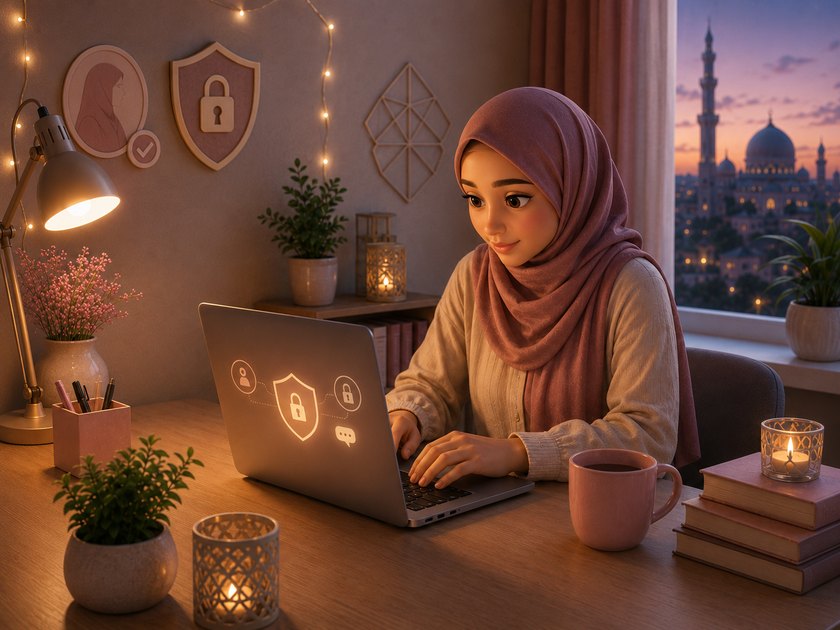
Receiving an insistent message, seeing a photo reshared without consent, or fearing that an account has been hacked can leave a real feeling of exposure. This digital security guide for Muslim women is not meant to make you live in suspicion, but to help you navigate online spaces with discernment, modesty, and peace of mind.
Digital security is also a way to preserve what belongs to you: your time, your image, your connections, your data, and your privacy. For a Muslim woman, it can be part of an approach of hayâ' (modesty), which protects dignity without preventing presence, exchange, or learning.
Digital security starts with your boundaries
Before settings and passwords, ask yourself a simple question: what do I want to keep private? There is no single valid answer. An entrepreneurial sister might need to make her activity visible, while a student, a convert, or a mother might prefer to protect her identity and daily life more.
Being cautious does not mean cutting yourself off from others. It means choosing what you share, with whom, and in what context. Your full name, address, phone number, workplace, usual routes, or information about your children do not have to be public for you to build connections.
The Quran teaches us a valuable principle regarding received information: “O you who have believed! If a wicked person brings you news, verify it” (Quran, 49:6). This verification reflex also applies to unknown accounts, offers that are too good to be true, urgent fundraisers, and messages that try to make you react in haste.
Digital security guide for Muslim women: the foundations
Protect each account with a unique password
Reusing the same password seems practical, until the day a single service suffers a leak. If this password also opens your email, social media, or bank account, a compromise can spread very quickly.
Prefer a long, personal, and hard-to-guess passphrase. Avoid names, birth dates, children's names, or references visible on your profiles. A password manager can help you create and store unique credentials without having to memorize them all.
Then enable two-factor authentication wherever it is offered, especially for your email. Your inbox is often the recovery key for all your other accounts. An authenticator app is generally more protective than a code sent by SMS, although SMS is still preferable to the absence of a second verification.
Make your inbox a highly monitored space
Phishing attempts are getting better and better at imitating banks, delivery platforms, associations, and sometimes even close ones. The message invites you to click, pay, confirm a package, or reset an access. It often plays on urgency: “your account will be closed”, “last chance”, “reply immediately”.
Take a few seconds before acting. Check the sender's address, unusual typos, the request made, and the tone used. A serious organization will not ask for your password by email or private message. In case of doubt, do not click: open the relevant app or official website yourself.
The Prophet ﷺ said: “Let whoever believes in Allah and the Last Day speak good or remain silent” (reported by al-Bukhari and Muslim). Online too, waiting before forwarding a rumor, a screenshot, or an unverified alert is a form of responsibility towards oneself and others.
Adjust the visibility of your photos and information
A photo can reveal more than one imagines: a recognizable place, a license plate, a school name, an address on a package, or the presence of another person who has not consented to appear. Before posting, observe the background and ask yourself if the image will still be comfortable to see in six months or two years.
Choose a limited audience when the content concerns your personal life. Disable automatic geolocation of your posts if it is not useful. Also avoid sharing your real-time location, especially when you are alone, traveling, or at an event.
Digital modesty is not limited to images. It also concerns conversations, voice notes, stories, and details shared in a moment of emotion. A private discussion can be captured and broadcast. This never justifies the betrayal of the person who shares without permission, but this reality invites you to carefully choose spaces and trusted interlocutors.
Recognize behaviors that should alert you
Certain signals deserve to be taken seriously from the start. A person who refuses verifiable calls, quickly asks for photos, insists on moving the exchange to a private app, or pushes you to keep a secret relationship is not respecting your boundaries.
Also be wary of money requests, even when they seem to come from an acquaintance. Their account may have been hacked. Always confirm by another means: a phone call, a voice message, or a question to which only the person concerned knows the answer.
Faced with harassment, you do not have to convince the person to stop or bear the weight of the situation alone. Keep useful evidence, block the account, report it on the platform, and talk to a trusted confidante. If threats, blackmail, or the dissemination of intimate content are involved, quickly seek help from authorities or a specialized association in your country.
Here are four reflexes to keep in mind when something makes you uncomfortable:
- do not respond under pressure;
- take screenshots before blocking;
- change your credentials if you think an account is compromised;
- warn a trusted person, even if you feel embarrassed.
The shame belongs to the person who harasses, manipulates, or broadcasts without consent, never to the one who seeks help.
Choose spaces that respect your privacy
Not all digital spaces are designed with the same priorities. A very open platform can favor visibility, but it often requires more vigilance: unsolicited requests, intrusive content, algorithms that encourage exposure, or interactions that do not respect your values.
A community space designed for Muslim women can offer a framework more consistent with your expectations of trust, modesty, and sisterhood. On Ukhti, sisters can gather around discussions, events, and halal discoveries in an environment oriented towards community rather than performance or overexposure.
This does not exempt you from keeping good habits. Even in a benevolent setting, do not share your codes, check profiles before a meeting, protect your loved ones' data, and listen to your intuition. Trust is precious, but it is built over time.
For convert sisters: move at your own pace
When discovering Islam or having just converted, resources, groups, and messages can come from all sides. This thirst for learning is beautiful, but some people may take advantage of it to impose their vision, create emotional dependence, or distance you from your bearings.
You have the right to take your time. Seek teachings attributed to recognized sources, exchange with several sisters, and do not let anyone make you believe that obedience to Allah requires accepting pressure, an ambiguous relationship, or isolation. A healthy community brings you closer to Allah with gentleness, knowledge, and respect.
Your online presence can remain useful, lively, and fraternal without becoming an open door to your privacy. Adjust a setting today, refuse a request that troubles you tomorrow, and then choose spaces where you feel respected. Protecting your digital life is also giving yourself the space to grow, learn, and weave sincere bonds between sisters, with serenity.